01First, this isn't your fault.
Most Americans never got taught this. You got World War II as battles and dates, a photo of a rally, and the general sense that fascism was bad and it happened somewhere else, a long time ago.
Then the word got worse. People started throwing it at teachers, cops, parents, politicians — anybody they didn't like. And once a word gets used that loosely, it stops meaning anything. It turns into noise that just means I'm mad at this.
Here's the problem with that. A word that means nothing can't warn you about anything.
If the word applies to everyone, it protects everyone.
So let's put the meaning back. It takes about eight minutes, and by the end you'll be able to spot the pattern yourself — and just as importantly, spot when someone's using the word on you unfairly.
02What it actually is.
Forget the uniforms and the flags for a second. Fascism isn't a policy platform. Historians who study it will tell you the movements were a mess on paper — contradictory, incoherent, constantly changing what they claimed to believe.
It's a method for taking power. And it follows a recognizable shape.
The standard academic definition comes from Robert Paxton, who taught at Columbia and wrote The Anatomy of Fascism. Stripped to plain English, it's this: a movement obsessed with the idea that the nation is in decline, humiliated, and victimized — which answers that feeling with promises of unity, strength, and purity, joins forces with the existing establishment, stops respecting democratic limits, and treats violence against internal enemies as necessary rather than shameful.
Two things worth knowing right away.
Judge what's done, not what's said.
Paxton's whole method. Nobody announces they're starting a fascist movement. Asking "did anyone say the word?" gets you nowhere. Watching what actually happens, over time, gets you everything.
It never breaks in. It gets invited.
This is the part almost nobody learns, and it's the most useful thing on this page. In Italy and Germany, fascists didn't overpower a united establishment. Respectable conservatives let them in — figuring the movement was useful, or controllable, or better than the alternative. Paxton's warning: the danger point is when mainstream politicians start borrowing the movement's methods and courting its followers.
03Why anybody falls for it.
Here's what the school version leaves out.
Nobody joins up because they want to be cruel. Paxton calls the engine underneath it “mobilizing passions” — the feelings that make it work. None of them feel evil from the inside:
- Something is badly wrong and normal politics can't fix it. A sense of real crisis.
- My town, my job, my country is going downhill. Genuine dread of decline.
- Somebody did this to us on purpose. Victimhood with a target attached.
- The problem is people who don't really belong here. The enemy gets located inside.
- Only strength and unity can save us now. And only one person can deliver it.
Every one of those feels like patriotism from where you're standing. Every one feels like somebody's finally telling you the truth. That's the entire trick — it doesn't recruit people who want to hurt anyone. It finds people who feel wronged and hands them somewhere to put it.
And it works on smart people. It's built against normal human wiring — fear of loss, loyalty to your own group, the pull of certainty when everything feels uncertain. Anybody who tells you only fools fall for propaganda is setting you up, because believing you're too clever to be worked on is the most useful thing a propagandist can put in your head. That's not our idea — it's the founding insight of the entire PR industry, and we laid it out on the Bernays page.
04You're looking for the wrong costume.
Most people scan for swastikas, jackboots, foreign accents, grainy black-and-white footage. If that's your checklist you'll never find a match — that was Germany in the 1930s, and this isn't.
Paxton addressed this himself. A new version would still need an enemy to point at, but it wouldn't necessarily be Jews. An American one, in his assessment, would be religious, would target Black Americans, and after 9/11 would take on an anti-Muslim edge. It would wear American clothes, because that's the only way it could ever work here.
You're not watching for a foreign uniform. You're watching for a familiar one.
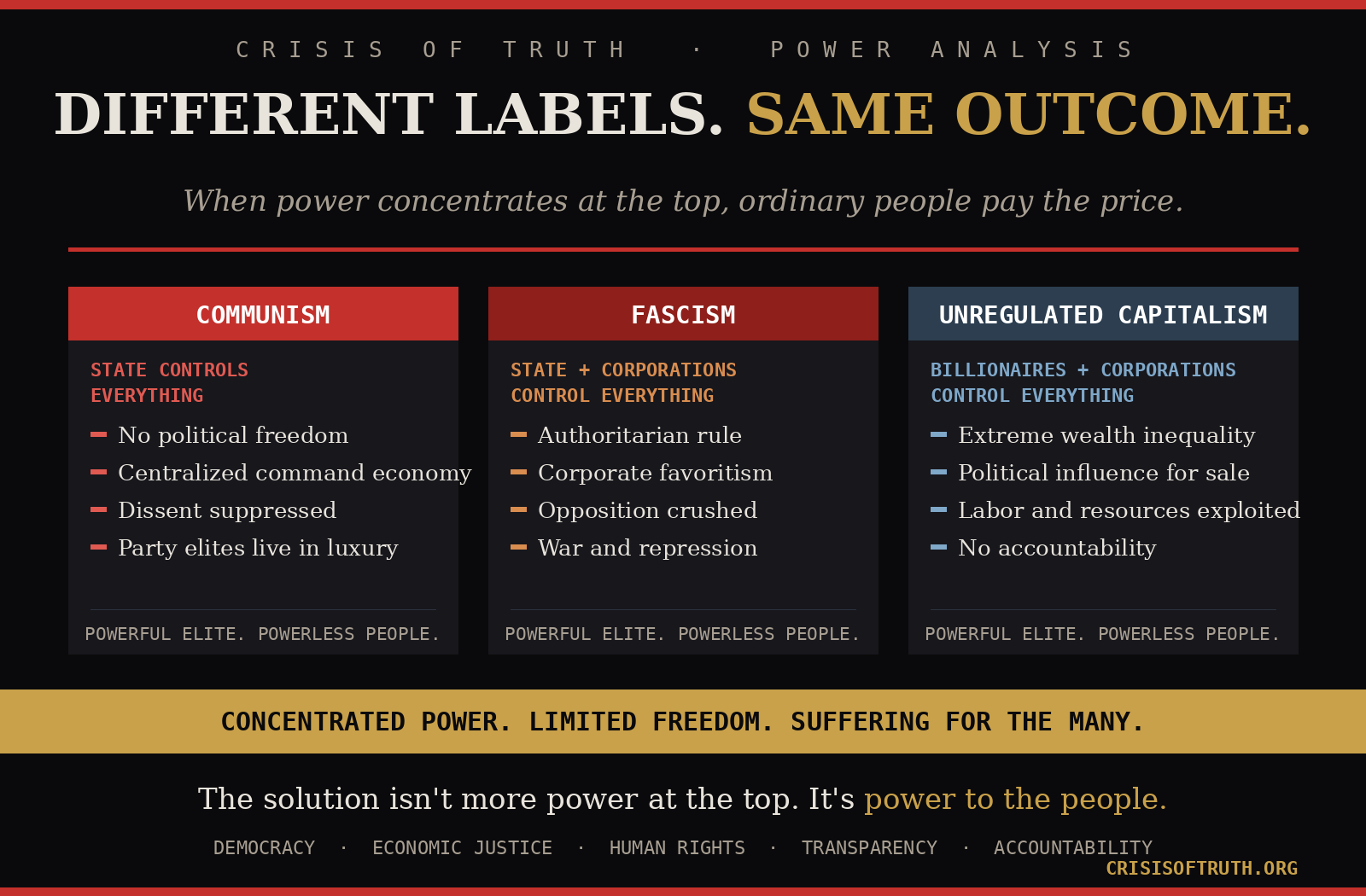
And once the costumes are off, the label matters less than people think. Communism, fascism, and unregulated capitalism sell three different stories — and land in the same place: power concentrated in a small elite, and ordinary people paying for it. Argue about the label later. Watch where the power sits.
05Then and now, side by side.
Same technique, different decade. Read both columns and judge for yourself. Nobody's claiming the two situations are identical — they aren't, and section 07 takes that objection seriously. The claim is narrower: the method is the same method.
The people who ran the original playbook weren't shy about how it worked. Opening the Berlin radio exhibition in August 1933, Goebbels told the audience that the Nazi seizure of power, in the form it took, “would have been impossible without the airplane and the radio.” Control of mass media wasn't a side effect of the takeover. By the chief propagandist's own account, it was a precondition.
Joseph Goebbels, “Der Rundfunk als achte Großmacht” (Radio as the Eighth Great Power), speech of Aug. 18, 1933, printed in Signale der neuen Zeit (Munich: Zentralverlag der NSDAP, 1938), pp. 197–207. English translation by Randall Bytwerk, German Propaganda Archive, Calvin University. Read the whole speech — don't take our excerpt for it.
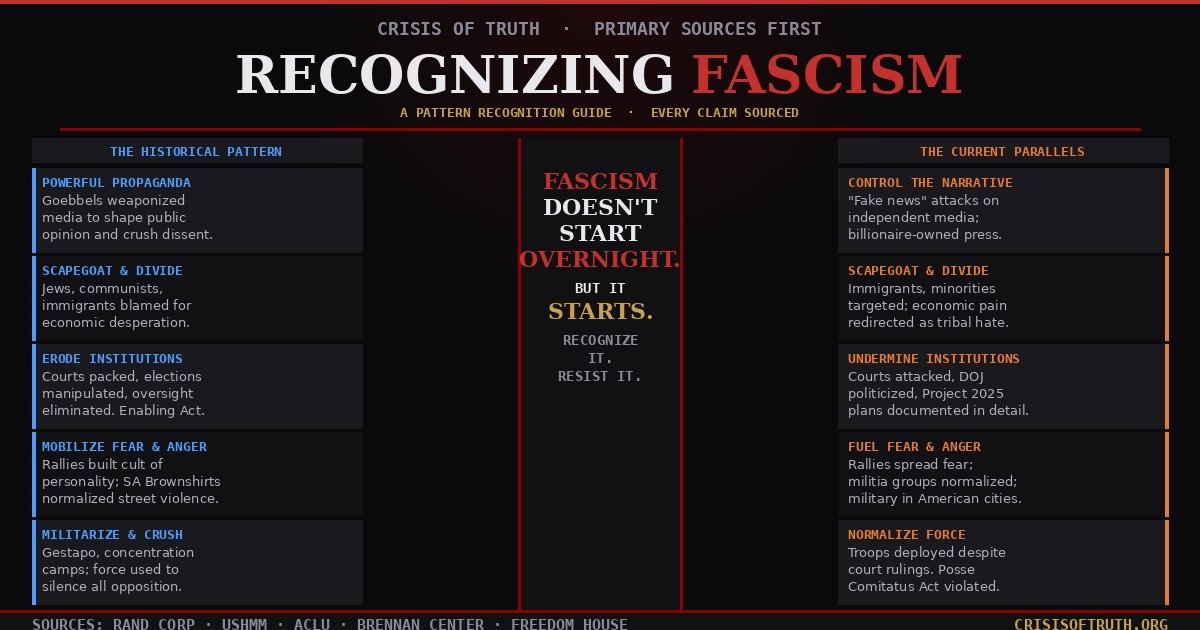
Nazi propaganda labeled independent newspapers the Lügenpresse — the lying press. Reporters who covered the government critically were recast as enemies of the people. That reframing made hostility toward journalists feel patriotic instead of dangerous.
US Holocaust Memorial Museum
“Enemy of the people” isn't a comparison here. It's the same phrase, said out loud, repeatedly, about American news organizations. Press-freedom groups have tracked the rise in threats against reporters that followed.
PEN America; Reporters Without Borders
Weimar Germany was genuinely broke — war debt, hyperinflation, then the Depression. Hitler didn't invent the suffering. He offered an explanation that pointed at minorities instead of at the economic order, plus a promise that he alone could fix it.
US Holocaust Memorial Museum
RAND found roughly $50 trillion moved from the bottom 90% of earners to the top 1% since 1975. About a third of American adults can't cover a $400 emergency. That desperation is real and documented — and it's sitting there for anyone with a scapegoat to offer.
RAND Corporation, 2020; Federal Reserve
This is the connection people miss. Fascism doesn't grow in comfortable places. It grows in desperation — and the desperation here didn't fall out of the sky. It was built by policy, decade by decade, with a paper trail you can read.
RAND analysts documented a Russian propaganda model they named the “firehose of falsehood” — high volume, many channels, constant repetition, zero concern about contradicting itself. The goal isn't to make you believe one lie. It's to make checking feel pointless.
RAND Corporation
RAND calls what it produces Truth Decay. When people can't tell what's real, they fall back on their team and on whoever sounds most certain. Facts stop working as a check on power — which is exactly the condition an authoritarian movement needs.
RAND Corporation, Truth Decay project
- US Holocaust Memorial Museum — the Enabling Act, 1933
- RAND — Trends in Income From 1975 to 2018 (the $50 trillion figure)
- RAND — The Russian “Firehose of Falsehood”
- RAND — Truth Decay
- Reporters Without Borders — US press freedom index
- Brennan Center — the Posse Comitatus Act
- Umberto Eco — “Ur-Fascism”, written by a man who grew up under Mussolini
06Your turn. Nothing is checked.
Most versions of this list show up with every box already ticked. That's not evidence — that's a conclusion dressed as evidence, and you should be suspicious of it. Including when we do it.
So these are blank. Read each one, decide honestly, and go look. The sources are right above and none of them are hard to find.
Nobody filled these in for you. That's the point.
- Is the press called an enemy, rather than just criticized for being wrong?
- Is there constant talk of national decline, humiliation, and lost greatness?
- Is economic pain blamed on minorities instead of on documented policy?
- Are judges called illegitimate when they rule the wrong way?
- Is force being used at home against civilians?
- Are emergency powers still running long after the emergency?
- Is political violence excused or rewarded instead of prosecuted?
- Are mainstream politicians copying the movement instead of resisting it?
- Is loyalty to one person being treated as loyalty to the country?
- Are you too worn out to check anymore?
How many did you mark? We're not going to tell you what the number means. If you did it honestly, you already know what you think — and you got there yourself, which means no slogan is going to talk you back out of it.
07The strongest case against this page.
Serious scholars disagree about whether the word fits modern America. Anybody who hides that from you is handling you. So here are the real objections, from real experts, put as strongly as they'd put them.
“There's no coherent revolutionary ideology, so the word doesn't apply.”
Roger Griffin, one of the most-cited scholars in the field, sees racism and authoritarianism but no coherent plan to overthrow the state — which he considers essential. Stanley Payne makes a similar case and prefers “authoritarian populism.” That's a real academic dispute, and it deserves weighing.
“The label is too blunt to be useful.”
Ruth Ben-Ghiat has argued since 2016 that Trump follows an authoritarian playbook — and has also written that the fascism label is in some ways too reductive, since he praises Communist dictators as readily as fascist ones. Her position is more precise than a single word.
“Look for patterns and you'll find them anywhere.”
True, and it's the trap this page could fall into. Which is why the checklist above is empty and every claim names its source. Test them. If one doesn't hold up, leave that box blank.
“Comparing anything to Nazi Germany is unserious.”
Comparison isn't equation. Saying a technique was used then and is used now is a statement about the technique. Nobody here is saying America is Nazi Germany — six million people were murdered, that has not happened here, and we're not going to cheapen it by pretending otherwise. The claim is narrower and checkable: the methods are documented, and they're recognizable.
“You're a partisan site, so of course you say this.”
Fair — so check the sources instead of us. Paxton is a Columbia emeritus historian. RAND was founded by the Air Force. The Holocaust Museum is a federal institution. Griffin and Payne, whose objections are printed above, don't agree with this page. They're here because an argument that can't survive its best objection isn't worth making.
08The one thing we'd point at first.
If you skim everything else, read this part.
Robert Paxton spent decades as the leading authority on fascism, and for years he publicly refused to use the word for Donald Trump. Reporters quoted him precisely because he wouldn't. He was the go-to reason for caution.
Then in January 2021, after the attack on the Capitol, he wrote in Newsweek that he'd changed his mind — that openly encouraging violence to overturn an election crossed a line he had drawn himself, and that the label had become not just acceptable but necessary.
Think about what that is. Not an activist arriving where he always wanted to be. A careful scholar in his eighties, publicly abandoning a position he'd defended for years, against his own instinct for caution, because of something specific he could no longer explain away.
People almost never change their minds in public. When someone spends a career resisting a conclusion and then accepts it, that's worth more than a thousand people who assumed it all along.
09What to actually do with this.
Not much of this is about voting, and none of it is about panic.
- Learn it well enough to explain it. Someone who can define the word precisely is much harder to manipulate — in either direction.
- Come back to the checklist in six months. It's a direction, not a snapshot. Which way it's moving matters more than where it is today.
- Watch what gets done, not what gets said. Paxton's whole method, and it costs you nothing to apply.
- Notice when respectable people start borrowing the moves. That's the specific warning sign, and almost nobody's watching for it.
- Keep receipts. Screenshots, dates, links. Normalization works by making you forget what normal looked like.
- Teach one person. Not by arguing. Hand them the definition and the sources and let them do what you just did.
Everything above traces to a named scholar, a federal institution, or a research organization. Go check. If we've got something wrong, tell us — we'll fix it in public and say so.