
What the Enabling Act Actually Was
The Enabling Act — formally titled the "Law to Remedy the Distress of People and Reich" — was passed by the German Reichstag on March 23, 1933. It passed with a two-thirds supermajority. Communist deputies had been arrested. Others were threatened or intimidated into absence. The Social Democrats voted against it. Every other party voted yes.
What the act did was simple and total: it transferred full legislative power from the parliament to Hitler's cabinet. The cabinet could now enact laws — including laws that deviated from the constitution — without Reichstag approval. The act was supposed to last four years. It was renewed twice.
The Enabling Act allowed the Reich government to issue laws without the consent of Germany's parliament, laying the foundation for the complete Nazification of German society.
— United States Holocaust Memorial MuseumThe act was not presented as an end to democracy. It was presented as a solution to a crisis. The Reichstag Fire — which gave Hitler the pretext for emergency decrees weeks earlier — had already suspended civil liberties. The Enabling Act was framed as the next logical step: a temporary measure to restore order. Serious people voted for it believing they were being responsible.

Germany went from a functioning constitutional democracy to a totalitarian state in less than two years. Not through a violent coup — through legislation, framed as emergency necessity.
The full text and historical analysis of the Enabling Act is maintained by the United States Holocaust Memorial Museum at encyclopedia.ushmm.org. The museum's mandate is historical documentation, not political commentary. See sources section below.

Side by Side: Then and Now
The structural parallels between the Enabling Act of 1933 and the One Big Beautiful Bill are not matters of opinion. They are matters of legislative architecture — what the laws do mechanically, not what they are called. Read the comparison below and follow the source links yourself.
Allowed laws to be enacted by the cabinet without Reichstag approval — including laws that violated the constitution. Parliament became ceremonial.
Uses the reconciliation process to bypass the Senate's 60-vote filibuster, inserting non-budgetary policy changes — AI regulations, court powers, healthcare — into a budget bill that only needs 51 votes.
Courts viewed the Hitler government as legitimate and did not challenge the act. Judicial independence collapsed rapidly as judges were replaced and intimidated.
Limits federal courts' ability to hold the executive branch in contempt. Legal analysts warn this could render 130+ existing desegregation orders and civil rights enforcement mechanisms unenforceable.
The Law for the Reconstruction of the Reich (1934) abolished state governments and transferred all administrative power to the central Reich government — without a separate vote.
Allows the executive branch to reorganize, consolidate, transfer, or eliminate federal agencies immediately — without requiring a separate Congressional authorization vote.
Banned independent trade unions and replaced them with the Nazi German Labour Front. Workers became structurally dependent on state-controlled institutions with no independent advocacy.
Cuts Medicaid by an estimated hundreds of billions, adds work requirements for SNAP food assistance for ages 55–64, and changes eligibility rules — while adding $3+ trillion in debt through tax cuts weighted toward the wealthy.
The Reichstag Fire Decree (February 1933) suspended civil liberties by declaring a Communist emergency. The emergency was real enough to frighten people; its use to seize power was not defensive.
Presented as a response to national emergencies including border security — using IEEPA (the International Emergency Economic Powers Act), a statute designed for genuine international crises, for routine domestic policy goals.
⚠ The "Temporary" Problem
The Enabling Act was passed as a temporary, four-year emergency measure. It was renewed. Emergency powers, once granted, have never in recorded history been voluntarily returned by the executive branch that holds them. The question is not whether the current administration would abuse expanded power — the question is whether any future administration would give it back.
How Fast a Democracy Falls
People often imagine authoritarianism arrives like an invasion — sudden, obvious, violent. The historical record shows something different: it arrives through legislation, through democratic processes, through people voting for stability. The timeline below shows how quickly Germany moved from a functioning democracy to a totalitarian state after the Enabling Act passed.
Appointed legally by President Hindenburg. Conservatives believed they could control him. He held no majority. The established parties thought they were managing him.
The Reichstag Fire Decree suspended civil liberties, including freedom of the press and assembly. Communist deputies were arrested. The emergency was used to justify permanent restrictions.
Passed with a two-thirds majority. Framed as temporary. Transferred full legislative power to the executive. The Reichstag never exercised independent authority again.
Independent labor organizations were banned. Assets were seized. Workers were forcibly enrolled in the Nazi Labour Front. Economic independence for working people: eliminated.
Four months after the Enabling Act. Every other political party in Germany was either dissolved or banned. From democracy to one-party rule: four months.
After Hindenburg's death, Hitler merged the offices of president and chancellor. He was now commander-in-chief, head of state, and head of government. The military swore an oath to him personally, not to the constitution. Total authoritarian control: 18 months from the Enabling Act.
The Propaganda Machine: How We Got Here
The Fairness Doctrine: Killing Balanced Media
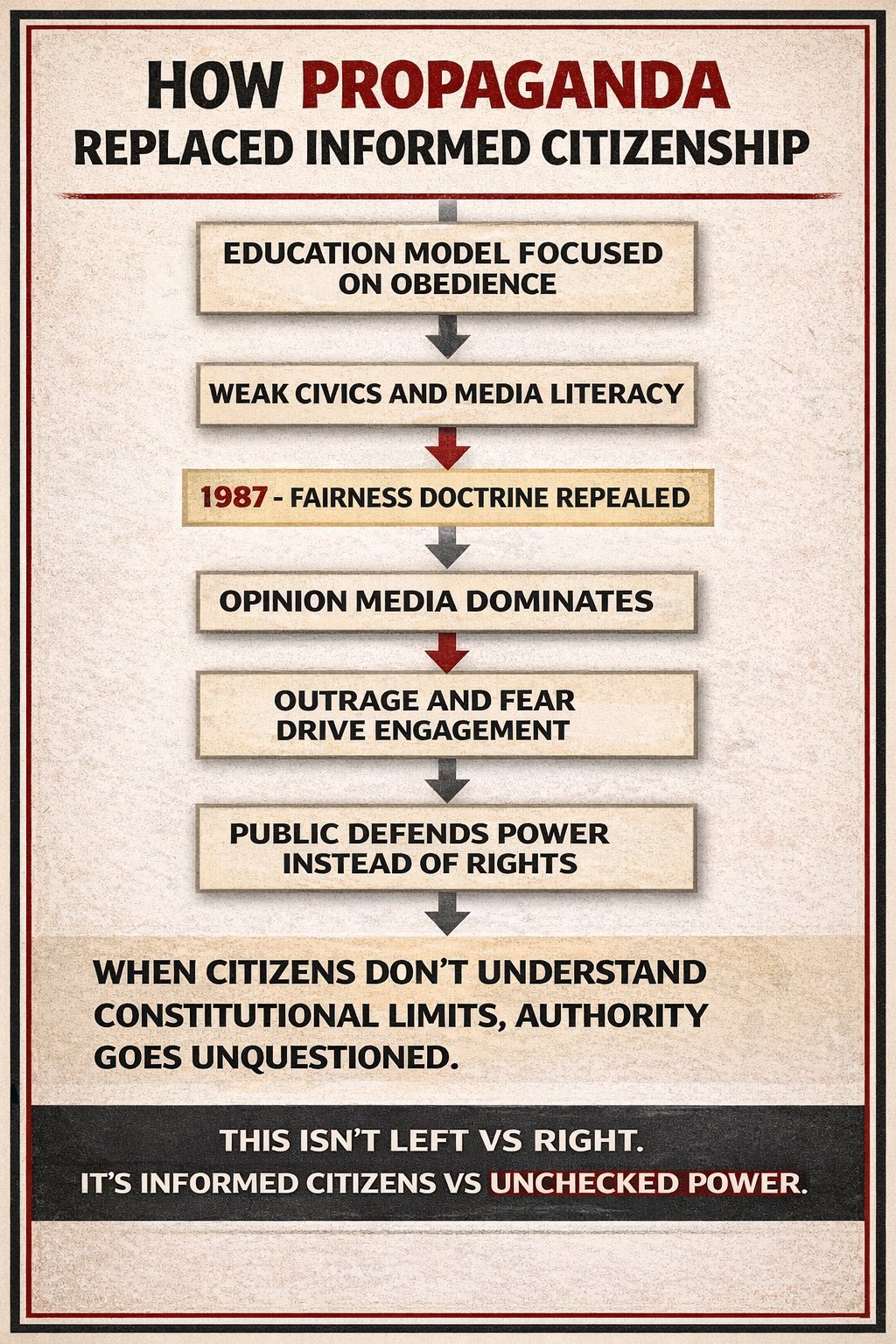
From 1949 to 1987, the FCC's Fairness Doctrine required broadcasters to present contrasting viewpoints on controversial public issues. It wasn't perfect — but it meant you couldn't run 24-hour one-sided political programming on publicly licensed airwaves.
In 1987, Reagan-appointed FCC Chairman Dennis Patrick eliminated it 4-0. Congress voted to reinstate it. Reagan vetoed the bill. One year later, Rush Limbaugh's show went national. That was not a coincidence.
In 1996, the Telecommunications Act relaxed media ownership rules. Six corporations came to control 90% of American media. Opinion programming — which is cheaper to produce and generates more engagement than investigative journalism — flooded the airwaves. The public could no longer tell the difference between news and entertainment, because the industry had stopped drawing the line.
FCC requires broadcasters using public airwaves to present both sides of controversial issues. Balanced political discourse required by law.
Reagan's FCC eliminates it. Congress passes a bill to reinstate it. Reagan vetoes it. The door to one-sided mass propaganda opens.
One year after repeal, one-sided political broadcasting goes national. Would have been illegal under the Fairness Doctrine.
Ownership rules relaxed. Six corporations eventually control 90% of American media. Investigative journalism collapses. Opinion fills the void.
Social media algorithms reward anger. Platforms profit from division. Citizens cannot distinguish news from entertainment. The propaganda is the product.
Misdirection in Action
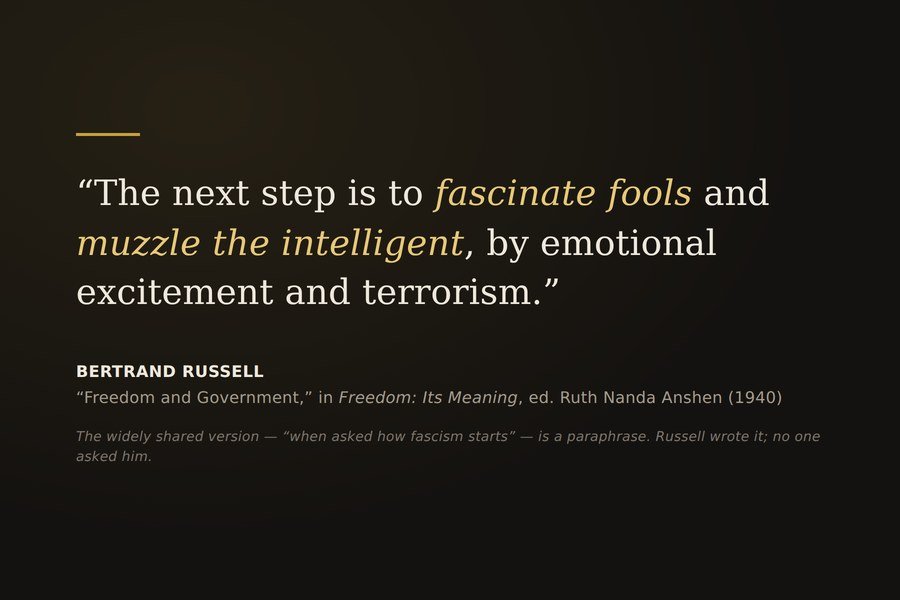
"If you tell a lie big enough and keep repeating it, people will eventually come to believe it. The lie can be maintained only for such time as the State can shield the people from the political, economic and/or military consequences of the lie."
— Joseph Goebbels, Reich Minister of Propaganda, 1930sThe technique Goebbels systematized — repeat a simple emotional message often enough until it becomes intuitive, not intellectual — is now encoded into recommendation algorithms running at machine speed, 24 hours a day, tailored individually to exploit each person's specific existing biases.
The scale is different. The technique is identical.
The Critical Thinking Crisis
The Numbers
94% of Americans believe critical thinking is important. 86% find those skills lacking in the public. 60% report they were never taught critical thinking in school. We were taught to follow instructions, not to question them. That was not an accident.
Standardized testing teaches there is one right answer and questioning is punished. Overloaded curricula leave no time for analysis or multiple perspectives. The defunding of public education means fewer teachers, larger classes, less individual attention. And the humanities — where critical thinking is explicitly taught — are dismissed as impractical compared to vocational training.
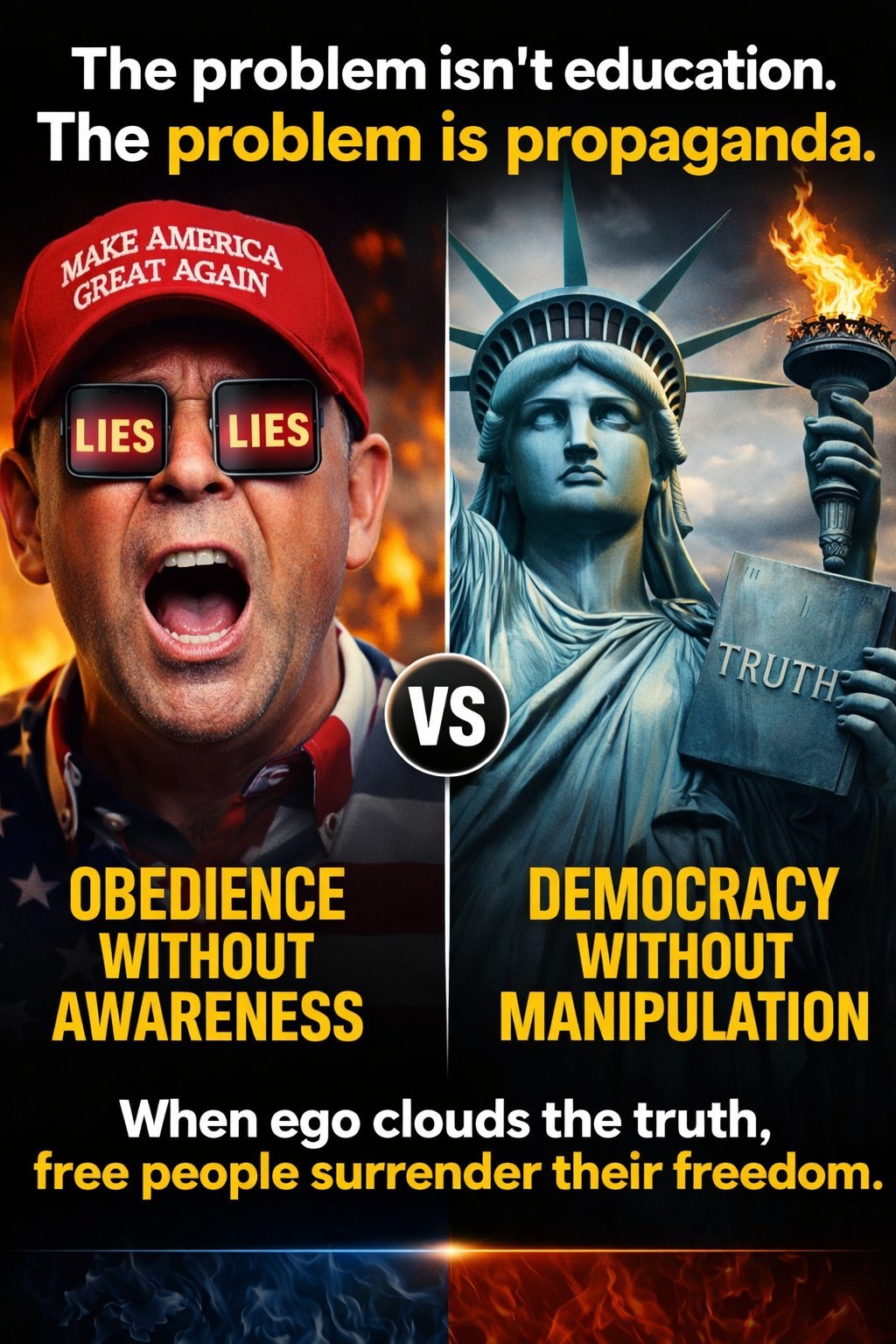
The result is a population that is highly confident in beliefs it has never examined, and deeply hostile to information that challenges those beliefs. That is not a failure of intelligence. It is the predictable outcome of a system designed to produce compliance, not citizens.
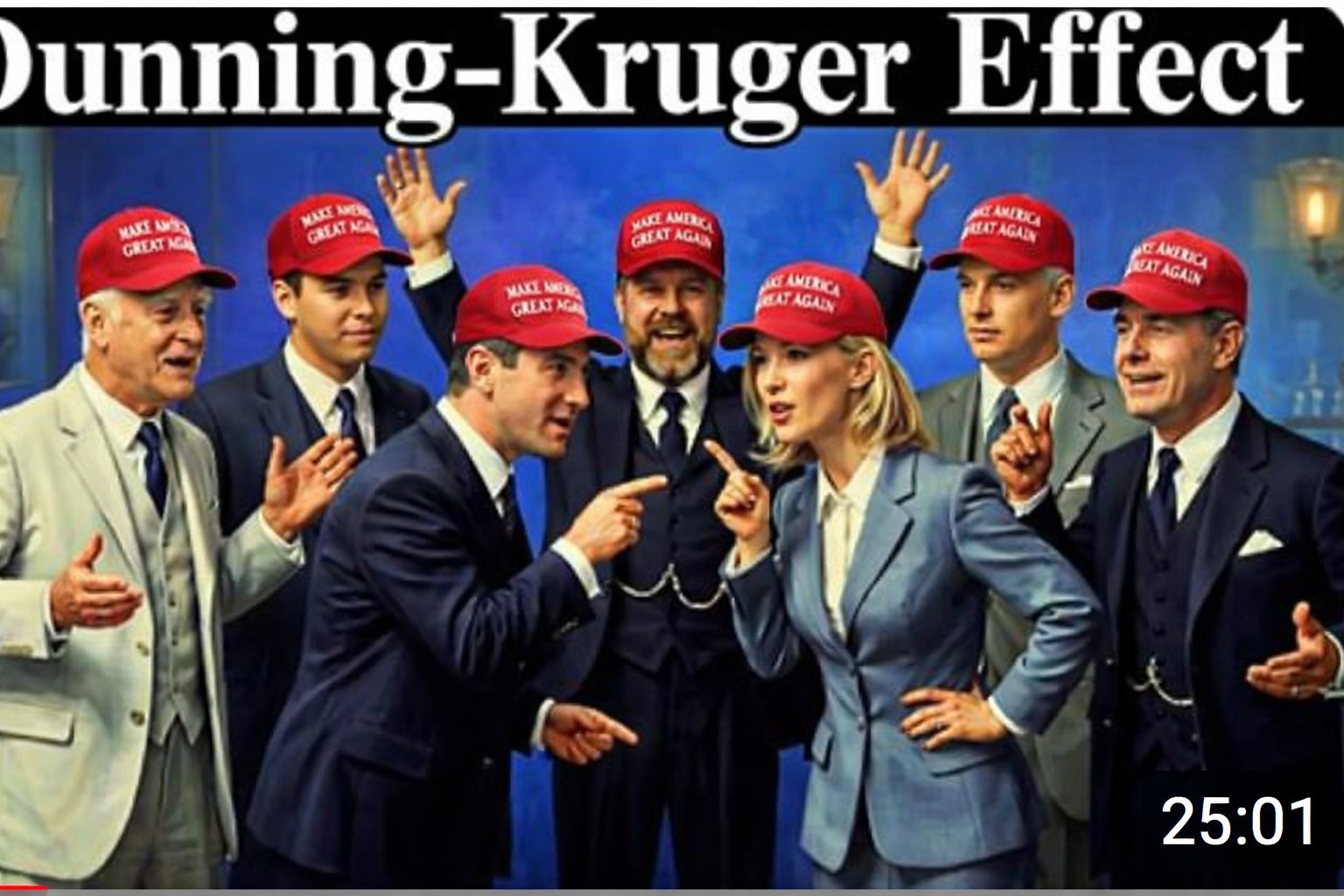
The Dunning-Kruger Effect: Confident Ignorance
The Dunning-Kruger effect, documented in a 1999 study published in the Journal of Personality and Social Psychology, describes a cognitive pattern in which people with limited knowledge in a domain significantly overestimate their own competence. Meanwhile, genuine experts tend to underestimate their abilities because they understand how much they don't know.
This is why the loudest, most confident voices are often the least informed. They don't know what they don't know — and they're certain they're right. Combine that with media designed to confirm biases rather than challenge them, algorithms that reward outrage, and a population never taught to evaluate evidence — and you get people who attack researchers for presenting documented facts.
The Real Class War: $80 Trillion Redistributed Upward
A RAND Corporation working paper — one of the most respected nonpartisan research institutions in the United States — calculated that $50 trillion was redistributed from the bottom 90% of Americans to the top 1% between 1975 and 2020. Updated analysis puts the current figure above $80 trillion.
This was not the result of market forces. It was the result of deliberate policy choices: tax cuts weighted toward capital income, the elimination of union protections, the deregulation of financial markets, the defunding of regulatory agencies, and trade agreements that prioritized corporate interests over worker protections.
The One Big Beautiful Bill — like the Enabling Act before it — concentrates power upward while creating dependency downward. Cutting Medicaid and SNAP while adding $3+ trillion in debt through tax cuts for the wealthy is not a budget decision. It is a class decision.
Constitutional Violations: The Record
The Fourth Amendment prohibits unreasonable searches and seizures. It applies to everyone on U.S. soil — citizens and non-citizens alike. Federal court filings document hundreds of cases of warrantless detention, searches without probable cause, and deportations without due process hearings.
The One Big Beautiful Bill's provision limiting courts' contempt powers (Section 70302) would make it significantly harder for federal judges to enforce their own orders when the executive branch ignores them. This is the structural equivalent of what happened in 1933: not eliminating courts, but making their rulings unenforceable against the executive.
Courts without enforcement mechanisms are suggestion boxes.
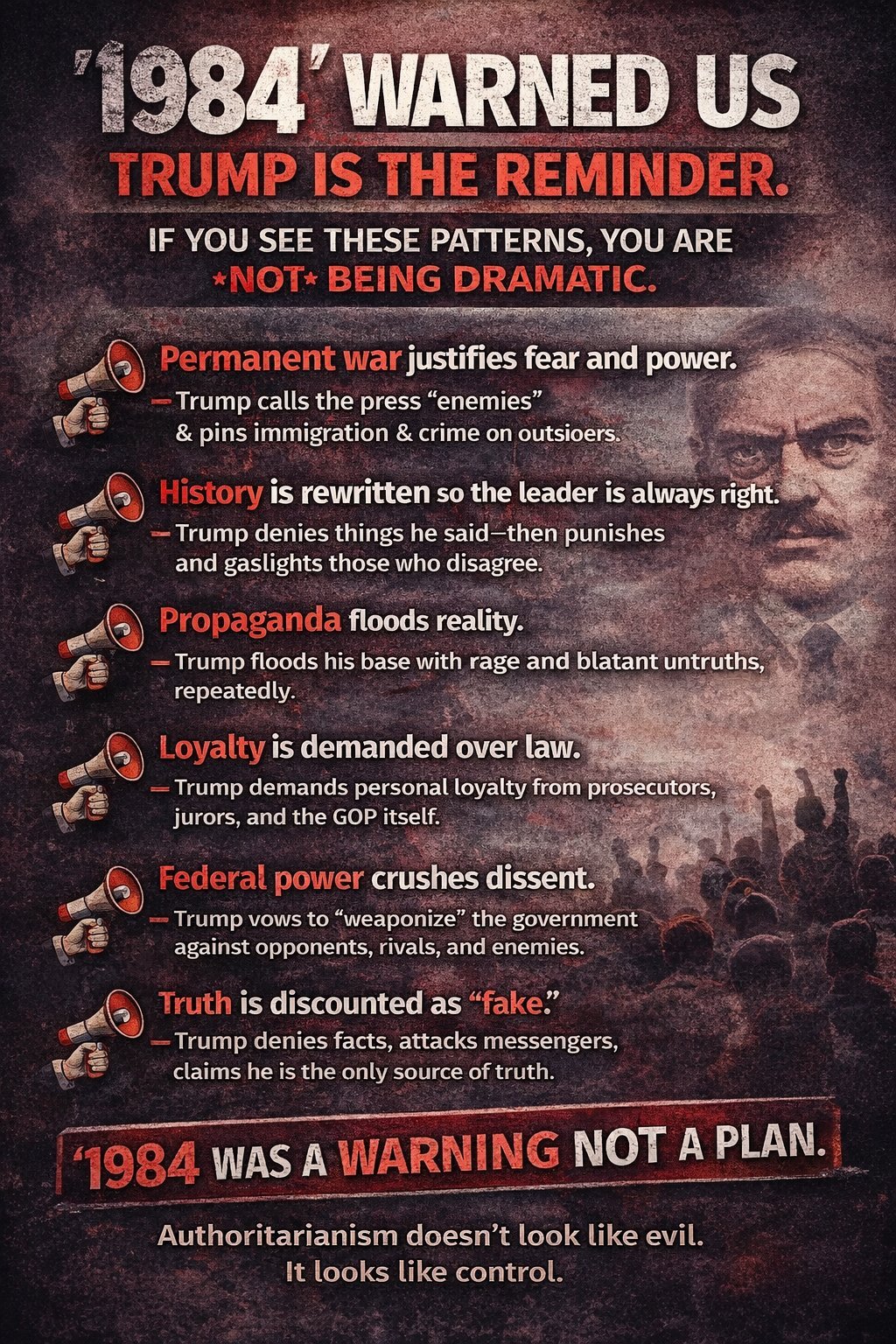
The Warning Signs — Check Them Off
Political scientists and historians who study democratic backsliding have identified consistent patterns. These are not opinions. They are observable, documented behaviors that have preceded the collapse of democracies across different countries and eras.
"The most chilling thing is not that these behaviors are new — it's that historians have seen them before and know exactly where they lead."
— Pattern across multiple democratic collapses — Levitsky & Ziblatt, How Democracies Die (2018)
What You Can Do
1. Read the Primary Sources
The full text of the One Big Beautiful Bill is public at Congress.gov. The Enabling Act is documented by the U.S. Holocaust Memorial Museum. Read both. Don't take anyone's word for the comparison — including ours.
2. Verify Before You Share
Every time a piece of emotionally charged content makes you want to share it immediately, wait. Find the primary source. Check who is funding the outlet. Ask what the headline leaves out. The propagandists are counting on your urgency.
3. Follow the Money
Ask who benefits from the policy being promoted. The One Big Beautiful Bill adds $3+ trillion to the national debt. That money goes somewhere — trace it. The Congressional Budget Office publishes nonpartisan scoring of every major bill. Read it.
4. Talk to People About Shared Economic Interests
The goal is not to win arguments — it's to help people think. Most Americans, regardless of party, want good jobs, affordable healthcare, and a fair economy. That is common ground. The culture war is designed to prevent working people from noticing they have more in common with each other than with the billionaires funding both parties.
Verify Everything: Primary Sources
Don't take our word for any of this. Every claim on this page can be verified through primary sources and nonpartisan institutions. Links below.
On the One Big Beautiful Bill
On the Enabling Act of 1933
- MuseumU.S. Holocaust Memorial Museum — The Enabling Act
- EncyclopediaBritannica — Enabling Act