Civic Literacy · Critical Thinking · Documented History
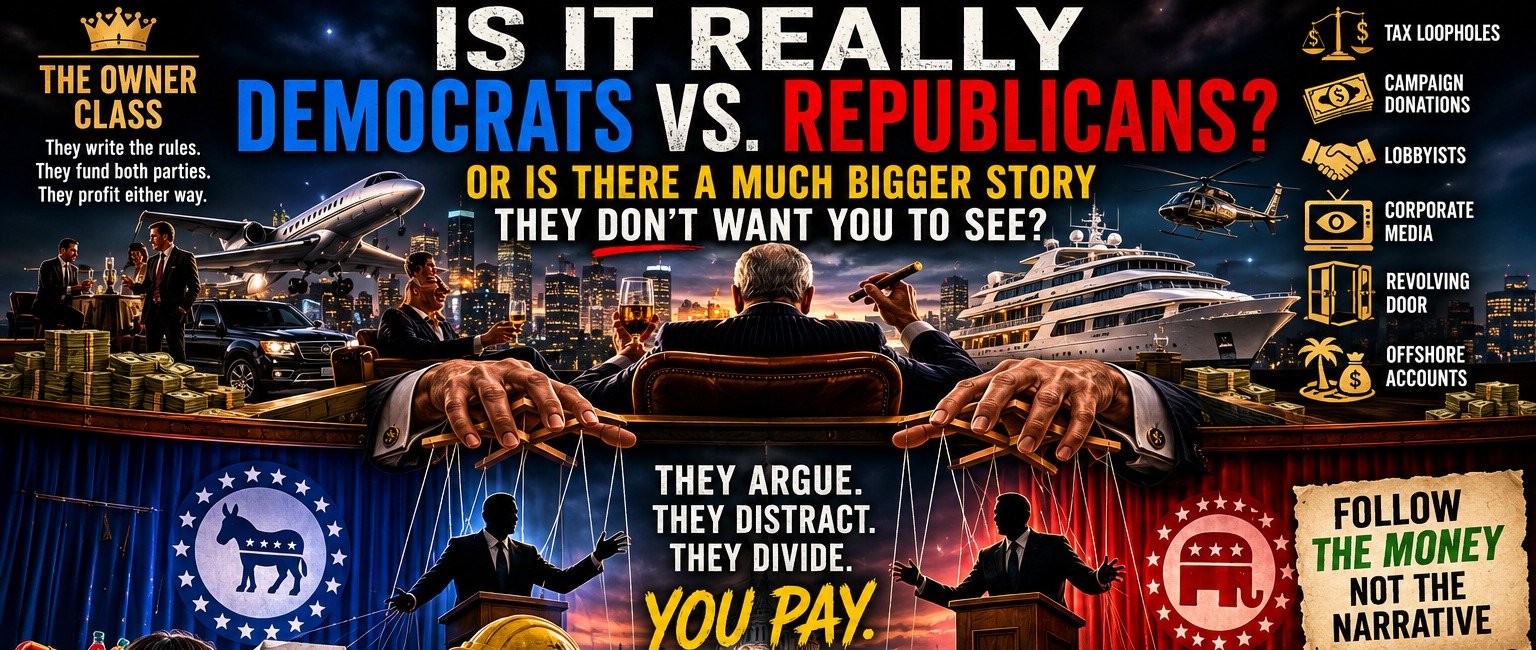
Is It Really Democrats vs. Republicans?
Or is there a much bigger story — one corporate media will never explain to you?
You have a strong opinion. That's fine. Most people do.
But before you defend your party, your team, your side —
meet the man who saw the whole machine clearly,
then answer seventeen questions without Googling.
Let's find out how deep the designed ignorance goes.
// George Carlin Wasn't Ranting. He Was Explaining the System.
Real power doesn't live with voters or politicians.
It lives with owners.
Massive corporate and financial interests that control land, corporations, media, courts, and the lawmakers who are supposed to represent you. Politicians are the front men — there to keep you believing you still have a choice.
The real owners of this country call all the shots — and they do it unknown to the public.
You cannot name them. You did not vote for them. You will never see their faces on a ballot. But every law that passes, every war that's funded, every tax break that's quietly slipped into a 2,000-page bill at 3 a.m. — they wrote it, or someone they paid wrote it for them.
What the owners don't want is a population that thinks critically.
They don't want people smart enough to sit at the kitchen table and figure out how badly they've been screwed for decades. That kind of thinking threatens the system.
What they do want is obedience.
Workers just smart enough to run the machines and fill out the paperwork
Just compliant enough to accept lower pay, longer hours, fewer benefits
Just desperate enough to tolerate disappearing pensions and stolen retirement funds
Education that never quite teaches real critical thinking — because that would expose the scam
The game is rigged.
The table is tilted.
And the people getting hurt keep voting for the same elites who profit from their pain.
And the most brutal truth of all? The system doesn't hate you. It doesn't even notice you. Nobody in power actually cares about you — unless you stop being obedient.
Carlin was a comedian. What follows are the primary sources — federal records, court decisions, peer-reviewed research — that prove he was also right.
Now Take the Test
Fourteen questions. No party labels. No spin. Every answer sourced to a primary document
— a court ruling, a federal record, a peer-reviewed study.
Let's find out what the designed ignorance actually cost you.
// Self-Assessment — No Cheating
Answer honestly. Every question has a documented, verifiable answer — no opinions, no spin. You'll see the source after each one.
QUESTION 01 / 17
The Supreme Court's 2010 Citizens United v. FEC decision. What did it actually do?
The ruling opened the floodgates. The 5-4 decision held that the First Amendment prohibits government from restricting political expenditures by corporations, associations, or labor unions. The result: unlimited "dark money" — untraceable, unaccountable — flooding American elections. Justice Stevens' 90-page dissent warned it would "undermine the integrity of elected institutions." He was right.
Source: Citizens United v. FEC, 558 U.S. 310 (2010) — Supreme Court of the United States
QUESTION 02 / 17
The First Amendment protects freedom of speech. What does it not protect against?
This is the single most misunderstood fact in American civic life. The First Amendment reads: "Congress shall make no law..." It restrains government. A private employer, a private platform, a private newspaper — none of them are bound by it. When someone says "my free speech is being violated" because Twitter muted them, they are constitutionally wrong.
Source: U.S. Constitution, First Amendment — Congress.gov
QUESTION 03 / 17
How many Supreme Court Justices does the Constitution specify?
The Constitution says nothing about nine justices. Article III creates "one supreme Court" and leaves the size to Congress. The number has changed six times — it was six at the start. Congress set it to nine in 1869 and it has stayed there, but that is a legislative choice, not a constitutional mandate. Anyone claiming "court packing is unconstitutional" does not know what the Constitution actually says.
Source: U.S. Constitution, Article III — Congress.gov
QUESTION 04 / 17
Justice Clarence Thomas received what from billionaire Harlan Crow over two decades, as documented by ProPublica in 2023?
The ProPublica investigation is meticulously documented. Thomas accepted over $4 million in gifts from Republican megadonor Harlan Crow — including 38 destination vacations, private jet travel worth hundreds of thousands of dollars, and a real estate deal involving his mother's home — none of which appeared on his required financial disclosures. The Supreme Court has no binding ethics code enforceable by any outside authority.
Source: ProPublica, "Clarence Thomas and the Billionaire" (2023)
QUESTION 05 / 17
The effective federal tax rate paid by the wealthiest 400 American families in 2018, compared to the bottom half of earners?
For the first time in U.S. history, the 400 wealthiest paid a lower overall tax rate than any other group. Economists Emmanuel Saez and Gabriel Zucman documented this using IRS data. The mechanism: billionaires earn through capital gains and stock, not wages. They borrow against assets rather than selling. They use foundations and trusts as legal shelters. This is not illegal. It is the tax code — written, lobbied, and maintained by their employees in Congress.
Source: Saez & Zucman, "Progressive Wealth Taxation" (2019) — Brookings Papers on Economic Activity
QUESTION 06 / 17
The Shelby County v. Holder (2013) Supreme Court ruling gutted what protection?
Within hours of the ruling, states began passing restrictive voting laws. The 5-4 decision invalidated the coverage formula of Section 4(b) of the Voting Rights Act, effectively nullifying Section 5's preclearance requirement. Chief Justice Roberts wrote that voting discrimination had changed "dramatically" — Justice Ginsburg's dissent compared it to "throwing away your umbrella in a rainstorm because you are not getting wet." Within 24 hours, Texas announced it would implement its voter ID law.
Source: Shelby County v. Holder, 570 U.S. 529 (2013) — Supreme Court of the United States
QUESTION 07 / 17
The Powell Memo — what was it and who wrote it?
This is the blueprint. Written two months before Powell was nominated to the Supreme Court, the memo called on corporations to fund think tanks, place executives on university boards, lobby legislatures, and build an ideological judiciary. It was the seed document for the Heritage Foundation, the Federalist Society, and the network Jane Mayer documents in Dark Money. It is publicly available from the Washington and Lee University archives.
Source: Powell Memorandum to U.S. Chamber of Commerce (August 23, 1971) — Washington & Lee University Archives
QUESTION 08 / 17
How does the U.S. rank among developed nations in social mobility — the ability of children born poor to become middle class or wealthy?
The "American Dream" now lives in Denmark. Harvard economist Raj Chetty's landmark study found that a child born in the bottom income quintile in the U.S. has about an 8% chance of reaching the top quintile — compared to 11.7% in Denmark. The Great Gatsby Curve, documented by economist Miles Corak, shows that countries with the highest income inequality also have the lowest social mobility. The U.S. is near the bottom of both lists among peer nations.
Source: Chetty et al., "Is the United States Still a Land of Opportunity?" (2014) — Opportunity Insights, Harvard
QUESTION 09 / 17
When Americans are polled on specific policy issues — without party labels attached — where does the electorate actually land?
Americans agree on more than they're told. When party labels are removed, polling consistently finds 60-80% supermajority support for: raising taxes on incomes over $400,000 (Gallup, 2021), allowing Medicare to negotiate drug prices (KFF, 2023), expanding background checks (Quinnipiac, 2023), and paid family leave (Pew Research, 2023). The partisan divide is real — but it is manufactured and amplified by a media ecosystem that profits from outrage. The actual policy distance between working-class Republicans and working-class Democrats is far smaller than either party's donor class.
Source: Pew Research Center, "Americans' Views of Government" (2023)
QUESTION 10 / 17
The U.S. corporate tax rate was cut from 35% to 21% by the Tax Cuts and Jobs Act of 2017. What happened to corporate investment in workers and infrastructure — as promised?
The money went to shareholders, not workers. The Federal Reserve Bank of San Francisco, the Congressional Budget Office, and the Congressional Research Service all found the 2017 tax cuts did not produce the promised business investment surge. Stock buybacks — which directly enrich shareholders and executives — hit a record $1.09 trillion in 2018 (Goldman Sachs data). The Congressional Research Service found no measurable effect on wages for median workers. The top 1% captured a disproportionate share of the benefits.
Source: Congressional Research Service, "Tax Cuts and Jobs Act" Economic Analysis (2019)
QUESTION 11 / 17
Under which president did the U.S. national debt increase the most in raw dollars?
The party of fiscal responsibility is a marketing slogan, not a documented fact. According to the Committee for a Responsible Federal Budget and U.S. Treasury data, the national debt grew by roughly $8.18 trillion under Trump's first term (2017-2021), more than under any prior single-term president in dollar terms. This includes the pre-pandemic 2017 tax cut, which the CBO projected would add $1.9 trillion over 10 years, and the CARES Act. Obama inherited the 2008 financial crisis; Bush started two unfunded wars. The debt grows under every president. The question is who it grows for.
Source: Committee for a Responsible Federal Budget, "Presidents' Fiscal Records" (2024)
QUESTION 12 / 17
What is the "revolving door" in Washington, and is it legal?
It is legal, it is documented, and it is how the system actually works. The Center for Responsive Politics (OpenSecrets) tracks thousands of these transitions. Former FDA commissioners go to pharmaceutical boards. Former EPA administrators join chemical company boards. Former congressional staffers who write banking regulations join the banks. There are nominal "cooling off" periods — typically one or two years — that are routinely navigated. The revolving door is not corruption in the legal sense. That's precisely the problem.
Source: OpenSecrets, "Revolving Door" Database
QUESTION 13 / 17
In his 1961 farewell address, President Dwight D. Eisenhower — a Republican five-star general who commanded Allied forces in World War II — warned Americans about what?
A five-star general who won World War II warned you. In 1961. Eisenhower's exact words: "In the councils of government, we must guard against the acquisition of unwarranted influence, whether sought or unsought, by the military-industrial complex. The potential for the disastrous rise of misplaced power exists and will persist." He was not a pacifist or a leftist. He was the Supreme Allied Commander in Europe. The address is preserved in full at the National Archives and is available to read in under 20 minutes.
Source: President Eisenhower's Farewell Address (January 17, 1961) — National Archives
QUESTION 14 / 17
The total cost of U.S. wars since 9/11, including veteran care and interest on borrowed war spending, as calculated by Brown University's Costs of War project?
The full number is almost never reported. Brown University's nonpartisan Costs of War project — peer-reviewed, primary-source accounting — puts the total federal price tag of post-9/11 wars at approximately $8 trillion when interest on borrowed funds is included. More than 900,000 people died in direct war violence. Between 2020 and 2024, private firms collected roughly $2.4 trillion in Pentagon contracts — about 54% of the department's entire discretionary budget in that period. Both parties voted for these budgets. Both parties took contractor donations. Major General Smedley Butler — winner of two Medals of Honor, the most decorated Marine of his era — concluded in 1935 that war is organized primarily to enrich banks and corporations. The arithmetic has not changed.
Source: Costs of War Project — Watson Institute, Brown University · Eisenhower Farewell Address, National Archives
QUESTION 15 / 17
The Fairness Doctrine — what was it, and what happened to it?
This is the policy decision that made partisan media legally possible. The Fairness Doctrine, established by the FCC in 1949, required any broadcaster using the public airwaves to present contrasting viewpoints on controversial public issues. Reagan's FCC eliminated it in August 1987, ruling it was no longer in the public interest. Congress passed the Fairness in Broadcasting Act to restore it. Reagan vetoed it. Within three years, Rush Limbaugh was nationally syndicated. Within a decade, Fox News existed. The infrastructure of one-sided outrage broadcasting was built on the legal vacancy the 1987 decision created. The public airwaves are still publicly owned. The obligation to serve the public interest is simply no longer enforced.
Source: FCC Broadcast Ownership Rules — FCC.gov · Fairness in Broadcasting Act of 1987 — Congress.gov
QUESTION 16 / 17
NAFTA — the North American Free Trade Agreement — was signed in 1994. What did peer-reviewed economic research document about its effects on American workers?
NAFTA was negotiated by a Republican president, signed by a Democratic president, and passed with primarily Republican congressional votes. George H.W. Bush negotiated it. Bill Clinton signed it. The majority of Democrats in Congress voted against it — it passed because Clinton whipped enough Democratic crossovers. The Economic Policy Institute documented more than 700,000 manufacturing job losses in the first decade. MIT economists David Autor, David Dorn, and Gordon Hanson — in peer-reviewed research published by the National Bureau of Economic Research — documented that communities which lost manufacturing jobs to trade competition experienced lasting increases in unemployment, disability claims, opioid addiction, and mortality. The communities hardest hit by NAFTA and the 2000 China trade deal are the same communities experiencing the highest rates of deaths of despair today. This is not a partisan argument. It is a documented geography.
Source: Economic Policy Institute, NAFTA's Impact on U.S. Workers · Autor, Dorn & Hanson, "The China Shock" — NBER (2016)
QUESTION 17 / 17
The Taft-Hartley Act of 1947 — what did it do, and how did it pass?
The dismantling of the New Deal began two years after World War II ended. The Wagner Act of 1935 had guaranteed workers the right to organize and bargain collectively — and union membership rose to 35% of the workforce, producing the broadest middle-class prosperity in American history. Taft-Hartley began reversing it. Passed over Truman's veto by a Republican Congress in 1947, it authorized states to ban union security agreements ("right-to-work" laws), allowed employers to permanently replace striking workers, and required union leaders to sign anti-Communist affidavits. Union membership has declined almost every decade since. Median wages stopped tracking productivity growth by the mid-1970s. The Economic Policy Institute's research documents that declining union membership explains approximately one-third of the growth in wage inequality since 1979.
Source: Labor Management Relations Act (Taft-Hartley), 80th Congress — Congress.gov · Economic Policy Institute, "Unions and Inequality" (2021)
—
out of 17 correct
// The Real Fight
You Are Not Fighting Your Neighbor. You Are Fighting for Him.
The owner class: they write the rules. They fund both parties. They profit either way.
"Most Americans cannot name a single one of them. That is not an accident. It is the entire design."
— Crisis of Truth · The case for who actually decides what happens to you
You've been handed two jerseys. Red. Blue. And told to pick one and hate the other.
The people handing you the jerseys are worth billions. They don't wear jerseys.
They own the stadium.
And the most important fact about them is the one corporate media will never report:
most Americans cannot name a single one of them.
"There are two ways to conquer and enslave a nation. One is by the sword. The other is by debt."
— John Adams, 2nd President of the United States
The Koch brothers funded Tea Party infrastructure. George Soros funded Democratic think tanks.
Both found the revolving door convenient. Both wrote checks to both parties' leadership PACs when
it served their interests. The donor class does not have a team. They have investments.
Jane Mayer's Dark Money — sourced entirely from court records, private archives, and named interviews —
documents how a network of ultra-wealthy donors built an ideological infrastructure over 50 years:
funding law schools, think tanks, judicial training programs, and state legislatures.
The goal was never Democrat versus Republican. The goal was to ensure that whichever party governed,
the tax code, the regulatory environment, and the judiciary served concentrated wealth.
$14.4B
Spent on the 2020 U.S. federal election cycle — the most expensive in history. The top 100 donors contributed more than the bottom 42 million combined.
Spent lobbying Congress in 2023 alone. For every member of Congress, there are approximately 24 registered lobbyists. Most represent corporate interests.
The share of Americans who make contributions of $200 or more — the donors who fund the majority of campaign finance in America. You are not among the decision-makers.
The donor class funding both parties is one layer of the story.
The deeper layer is how they built an information environment designed to make sure
you would never connect the dots. It took three specific policy decisions,
spanning three decades, under both parties.
1987
Reagan Eliminates the Fairness Doctrine
Since 1949, the FCC's Fairness Doctrine required any broadcaster using the public airwaves
to present contrasting viewpoints on controversial public issues. In August 1987,
Reagan's FCC eliminated it — ruling it was "no longer in the public interest."
Congress passed the Fairness in Broadcasting Act to restore it.
Reagan vetoed the bill. No president since has moved to reinstate it.
Within three years of the elimination, Rush Limbaugh was nationally syndicated.
Within a decade, Fox News existed. The entire architecture of one-sided outrage broadcasting
was built on the legal vacancy the 1987 decision created.
The public airwaves are still publicly owned. The obligation to inform rather than inflame
is simply no longer enforced.
The North American Free Trade Agreement was negotiated under George H.W. Bush and signed into law
by Bill Clinton — passed primarily on Republican votes, opposed by the majority of congressional Democrats,
and pushed through with Clinton's active lobbying effort against his own party's base.
It is the textbook example of the donor class operating across party lines.
The Economic Policy Institute documented more than 700,000 U.S. manufacturing jobs lost in the first decade.
MIT economists Autor, Dorn, and Hanson — in peer-reviewed research published by the National Bureau of Economic Research —
documented that the specific communities which lost those jobs experienced lasting increases in
unemployment, disability claims, opioid addiction, and mortality.
The geography of NAFTA's job losses maps almost exactly onto the geography of today's deaths of despair.
The Telecommunications Act — Clinton Opens the Floodgates
Two years after NAFTA, the Telecommunications Act of 1996 eliminated most media ownership caps —
allowing a small number of corporations to buy up radio stations, television stations,
newspapers, and media networks across the country simultaneously.
Before the Act, one company could own a maximum of 40 radio stations nationwide.
After it, Clear Channel alone eventually owned more than 1,200.
Local journalism collapsed. Independent voices disappeared.
National outrage programming — cheaper to produce, more profitable to air,
requiring no local reporters or accountability journalism — filled the void.
By 2012, six corporations controlled approximately 90% of what Americans watched, read, and listened to —
down from 50 companies in 1983. That consolidation happened in 16 years.
It was not an accident of the marketplace. It was a policy decision signed into law.
In 2000, Congress granted China Permanent Normal Trade Relations —
opening the door to unrestricted manufacturing competition with a country
where wages were a fraction of American levels and environmental and labor regulations were nonexistent.
Signed by Clinton, passed with bipartisan support, lobbied for aggressively by multinational corporations
whose executives sat on the boards of the same media companies now consolidating under the Telecom Act.
Autor's peer-reviewed research documented approximately 2 million additional manufacturing jobs lost between 2000 and 2007
as a direct result of Chinese import competition. Combined with NAFTA, the two trade deals
produced a systematic dismantling of working-class economic security
while corporate profits and executive compensation reached historic highs.
Both parties voted for it. Neither party's working-class voters were consulted.
"A democracy cannot function properly when a small number of corporations decide what stories matter, what voices get amplified, and what narratives get repeated 24 hours a day."
Number of corporations controlling 90% of U.S. media: 50 companies in 1983, six corporations by 2012. The Telecommunications Act of 1996 made it legal. Clinton signed it.
U.S. manufacturing jobs documented lost in NAFTA's first decade by the Economic Policy Institute. Those communities now lead the country in opioid deaths, disability claims, and economic despair.
The year the legal requirement to present balanced viewpoints on public airwaves was eliminated. Congress voted to restore it. The president vetoed it. The one-sided media landscape you live in was built in the years that followed.
War Is Not a Last Resort. For Some, It's a Revenue Stream.
This is not a left-wing argument. It is the documented conclusion of the most decorated
Marine in American history — a man who won two Medals of Honor and spent 33 years
fighting in wars he later believed were fought for banks and corporations, not for the country.
"War is a racket. It always has been. It is possibly the oldest, easily the most profitable, surely the most vicious."
— Major General Smedley D. Butler, USMC, two-time Medal of Honor recipient, War Is A Racket (1935)
Butler commanded American forces in interventions across Central America, the Caribbean, and China.
By the time he wrote War Is A Racket, he had reached a conclusion that had nothing to do with party affiliation:
the pattern was too consistent to be coincidental. Wars are planned, funded, and ended in ways that systematically
enrich a small number of private interests while the cost — in lives and debt — is borne entirely by the public.
Eisenhower made the same argument 26 years later, from the same vantage point of someone who had seen it from the inside.
His farewell address — available in full at the National Archives — used the phrase "military-industrial complex"
to describe a permanent fusion of defense contractors, the Pentagon, and congressional appropriations that
had become, in his words, a threat to democratic institutions. Neither man was a peacenik.
Both had spent their careers in uniform. That is precisely why their conclusions matter.
$8T
Total cost of U.S. wars since 9/11, including interest on borrowed funds and projected veteran care — per Brown University's peer-reviewed Costs of War project. More than 900,000 people died in direct war violence.
Collected by private contractors from Pentagon budgets between 2020 and 2024 — approximately 54% of the department's entire discretionary spending. That is not a side effect of war. That is the business model.
Time between 9/11 and passage of the USA PATRIOT Act — 342 pages of surveillance law that rewrote what the government could legally watch, collect, and store about American citizens. Few members of Congress read it before voting.
Defense-industry lobbying and campaign contributions are publicly tracked and searchable by name.
The donors are not secret. The votes are not secret. The contracts are public record.
The only thing missing is the habit of looking.
Nine unelected justices with lifetime appointments, no binding ethics code, and no mechanism for removal
except impeachment — which has never succeeded. This is the institution that now has final say
over your vote, your body, your air, and your water.
These are not opinions. They are documented decisions with case citations available to anyone.
2010
Citizens United v. FEC — Money Becomes Speech
The 5-4 ruling eliminated limits on corporate and union political spending, holding that money equals speech and corporations hold First Amendment rights equal to individual citizens. The result was the Super PAC era and the explosion of untraceable "dark money" in American politics.
Shelby County v. Holder — Gutting the Voting Rights Act
The Court invalidated the coverage formula that determined which states needed federal approval before changing voting laws. Within hours, states previously covered by the formula began implementing restrictive voting measures. The Voting Rights Act of 1965 — passed after documented violence against citizens trying to vote — was effectively neutered without being repealed by Congress.
West Virginia v. EPA — Stripping Regulatory Authority
The "major questions doctrine" invented in this ruling held that agencies cannot take major regulatory actions without explicit congressional authorization. It effectively paralyzed the EPA's ability to regulate carbon emissions. The same doctrine is now being used to challenge FDA authority over pharmaceuticals, FTC authority over mergers, and SEC authority over financial markets.
Trump v. United States — Presidential Immunity Doctrine
A 6-3 ruling holding that former presidents have absolute immunity for "core" official acts and presumptive immunity for other official acts. Justice Sotomayor's dissent: "The President of the United States is the most powerful person in the country, and possibly the world. When he uses his official powers in any way, under today's decision, he will now be insulated from criminal prosecution." She noted it makes the president a king in all but name.
Thomas and Alito — Undisclosed Gifts from Republican Megadonors
ProPublica documented that Justice Clarence Thomas accepted over $4 million in gifts from Harlan Crow, a Republican megadonor with interests before the Court, over more than two decades — none disclosed. Justice Samuel Alito accepted luxury travel from hedge fund billionaire Paul Singer, whose companies had cases before the Court, and did not recuse himself. The Supreme Court has no binding ethics authority beyond self-policing.
Critical thinking, civics, media literacy, logical fallacies, how to read a tax document,
how to evaluate a source — these were largely absent from American public education.
That is not an accident.
An informed population asks inconvenient questions. A confused population argues about
flags and pronouns while the tax code is quietly rewritten.
The goal of a functional democracy is not for you to pick a team. It's for you to know the rules of the game.
// Before You Share Anything — Five Questions
01What is the primary source? Not a tweet, not a meme, not a news segment summarizing a study. The actual document, the actual data, the actual record.
02Who benefits if you believe this? Every piece of political content is designed to produce a reaction. Follow the money behind who created it and distributed it.
03What would prove this wrong? If you cannot name evidence that would change your mind, you don't have a belief — you have a loyalty. Those are different things.
04Is this a fact or a framing? "The deficit increased by $X" is a fact. "Democrats/Republicans destroyed the economy" is a framing. One is verifiable. One is a product being sold to you.
05Who is missing from this story? Every political narrative has a villain and a hero. Ask who is not mentioned, whose interests are not represented, and what the documented alternative explanation is.
"None of us knows everything. I certainly don't. What matters is being willing to learn, change our minds when the facts change, and take the time to understand an issue before forming strong opinions."
— Crisis of Truth
// The Middle Class Was Built — Then Dismantled
They Built It. Then They Spent 70 Years Taking It Apart.
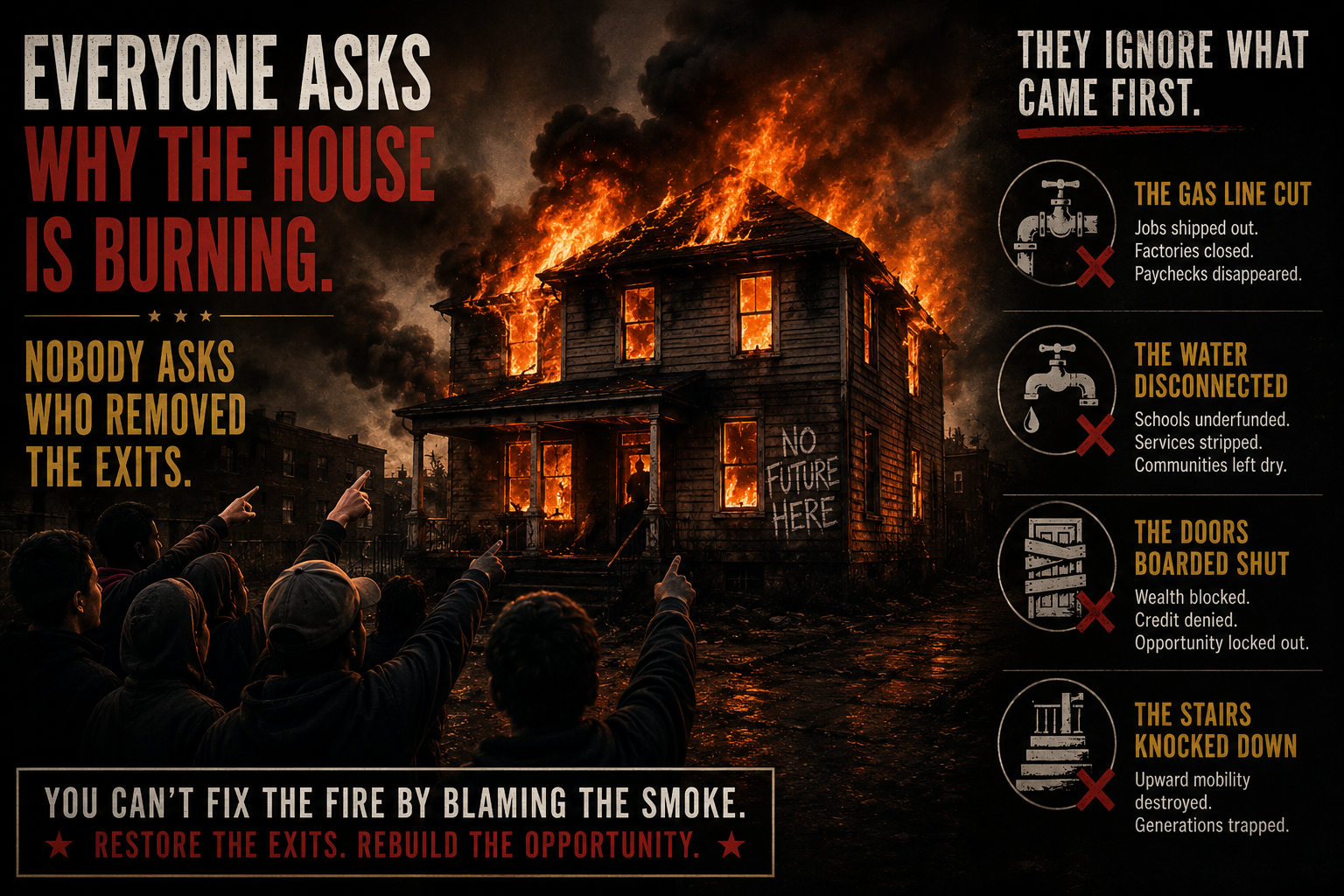
Nobody asks who removed the exits.
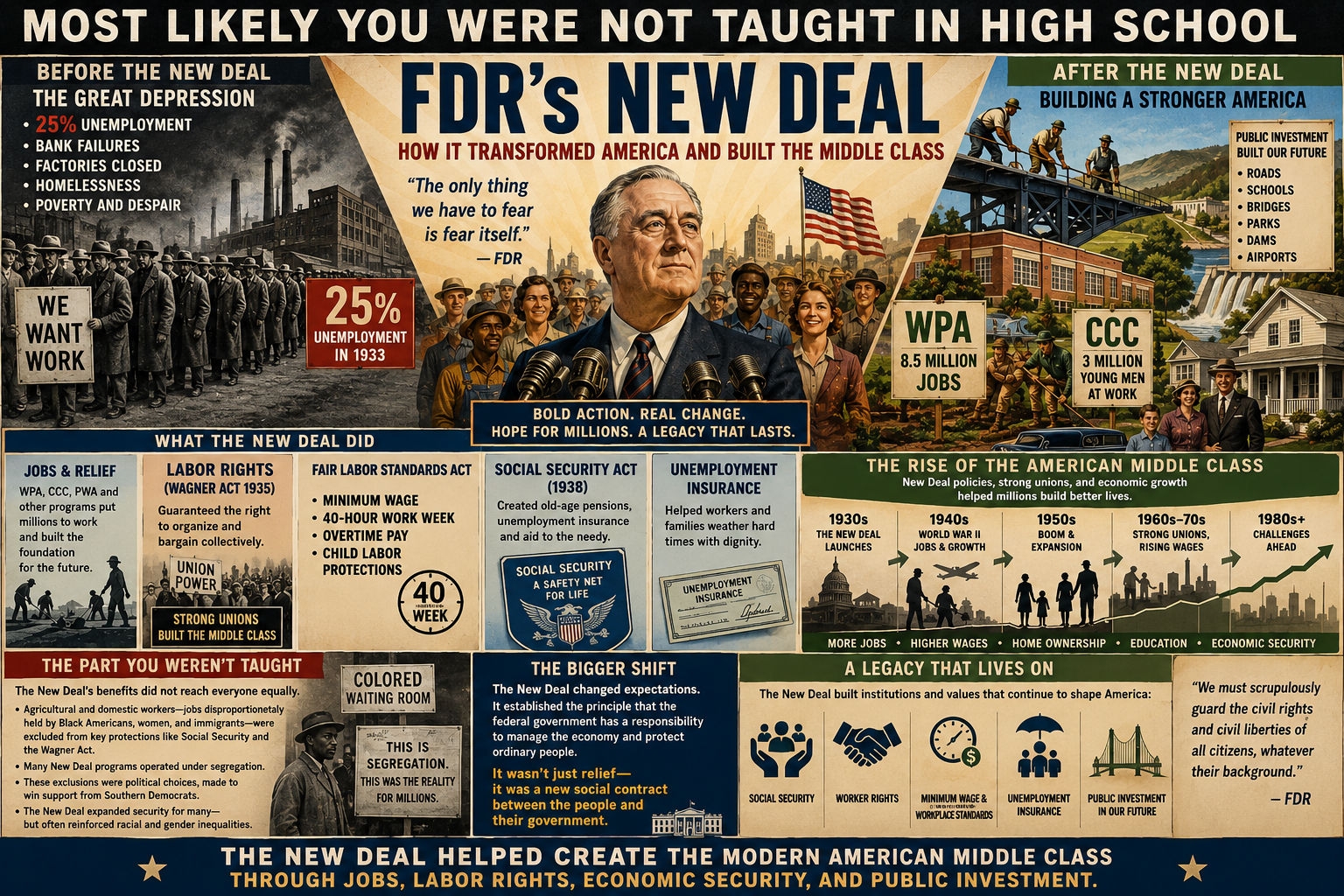
Between 1935 and 1975, median wages rose in near-lockstep with productivity.
Workers shared in the gains of the economy they built. That period produced
the broadest middle-class prosperity in American history.
It did not happen by accident. It happened because of specific laws —
and it ended because of specific laws designed to reverse them.
"This is no time to be making America safe for the return of the Wall Street economic royalists."
— President Harry S. Truman, veto message of the Taft-Hartley Act, June 20, 1947 — National Archives
1935
The Wagner Act — Workers Get the Right to Organize
The National Labor Relations Act guaranteed workers the right to unionize and bargain collectively. Union membership rose to 35% of the workforce. Between 1947 and 1973, productivity and median wages rose together — working people shared in the economy they built. The NLRA is the legal foundation the New Deal rested on.
Passed by a Republican Congress over Truman's veto, Taft-Hartley authorized states to pass "right-to-work" laws undermining union security, permitted employers to permanently replace striking workers, restricted union political activity, and required union leaders to sign anti-Communist affidavits. Truman's veto message called it a "slave labor bill." Congress overrode him 331-83 in the House. Union membership began its long decline within a decade. The Economic Policy Institute documents that declining union membership explains approximately one-third of the growth in wage inequality since 1979.
Reagan Breaks PATCO — Open Season on Organized Labor
When 11,000 air traffic controllers went on strike, Reagan fired every one of them and banned them from federal employment for life. It was the single most consequential labor action in postwar American history — not because of the strike itself, but because of what it signaled: that employers could break unions without political cost. Private sector union busting accelerated immediately. By 2023 union membership had fallen to 10% of the workforce — a 25-point collapse from its peak, tracking almost exactly with the stagnation of median wages relative to productivity.
The Glass-Steagall Act of 1933 had separated commercial banking from investment banking — preventing banks from gambling with depositors' money. The Gramm-Leach-Bliley Act repealed those separations. Signed by Clinton, passed with overwhelming bipartisan support. Nine years later, the largest financial crisis since the Great Depression wiped out approximately $13 trillion in household wealth, eliminated 8.7 million jobs, and required a $700 billion public bailout of the same institutions whose deregulation caused the crash. Not one senior banking executive was criminally prosecuted.
Janus v. AFSCME — The Supreme Court Defunds Public Unions
The 5-4 decision held that requiring public employees to pay union fees violated the First Amendment — overturning 41 years of settled law. The practical effect: public sector unions lost a substantial portion of their funding base overnight. Justice Kagan's dissent: "The majority overthrows a decision entrenched in this Nation's law — and in its economic life — for over 40 years." The decision was brought by a conservative legal organization funded by donors also documented in Jane Mayer's Dark Money network. The Powell Memo's call to build an ideological judiciary took 47 years to reach this result.
Union membership as a share of the U.S. workforce: peak of approximately 35% in the mid-1950s, collapsed to 10% by 2023. Wage stagnation tracks this decline almost exactly. This is not coincidence. It is documented cause and effect.
The year productivity and median wages stopped rising together. Before 1973: workers shared in economic growth. After 1973: productivity continued rising, wages flatlined. The divergence maps directly onto the legislative dismantling of labor protections.
Household wealth destroyed in the 2008 financial crisis — the direct consequence of repealing Glass-Steagall's firewall between commercial and investment banking. The bankers were bailed out. The homeowners were not. No senior executives faced criminal prosecution.
FDR's New Deal built the American middle class through jobs, labor rights, and public investment. The part that's always left out: it was systematically dismantled beginning in 1947 — and the people dismantling it funded the politicians who told you government was the problem.
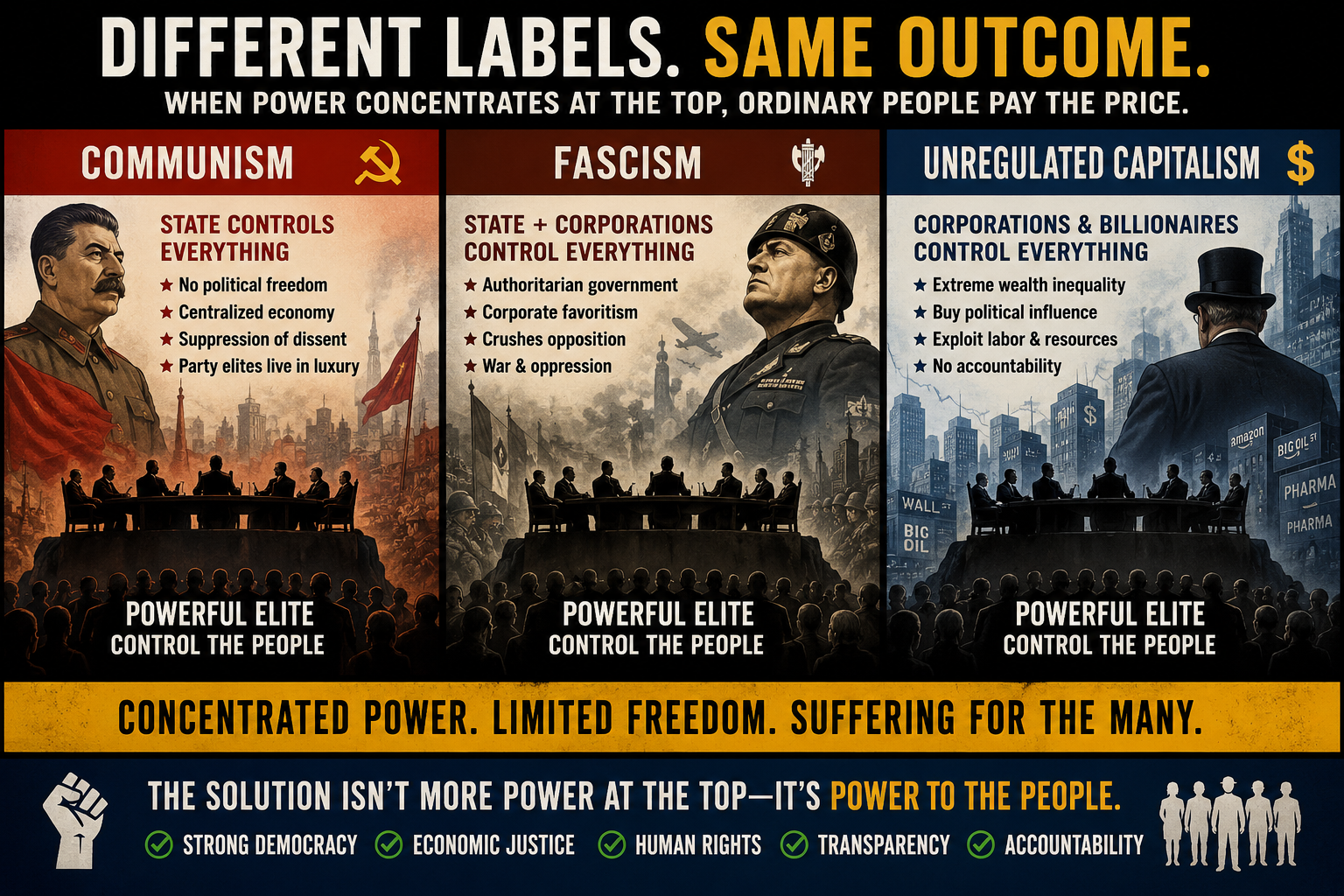
Different Labels. Same Outcome.
Communism, Fascism, Unregulated Capitalism — three different words for the same arrangement: a powerful elite controls the decisions, and everyone else lives with the consequences. The label changes. The structure doesn't.
What They Tell You vs. What They Don't
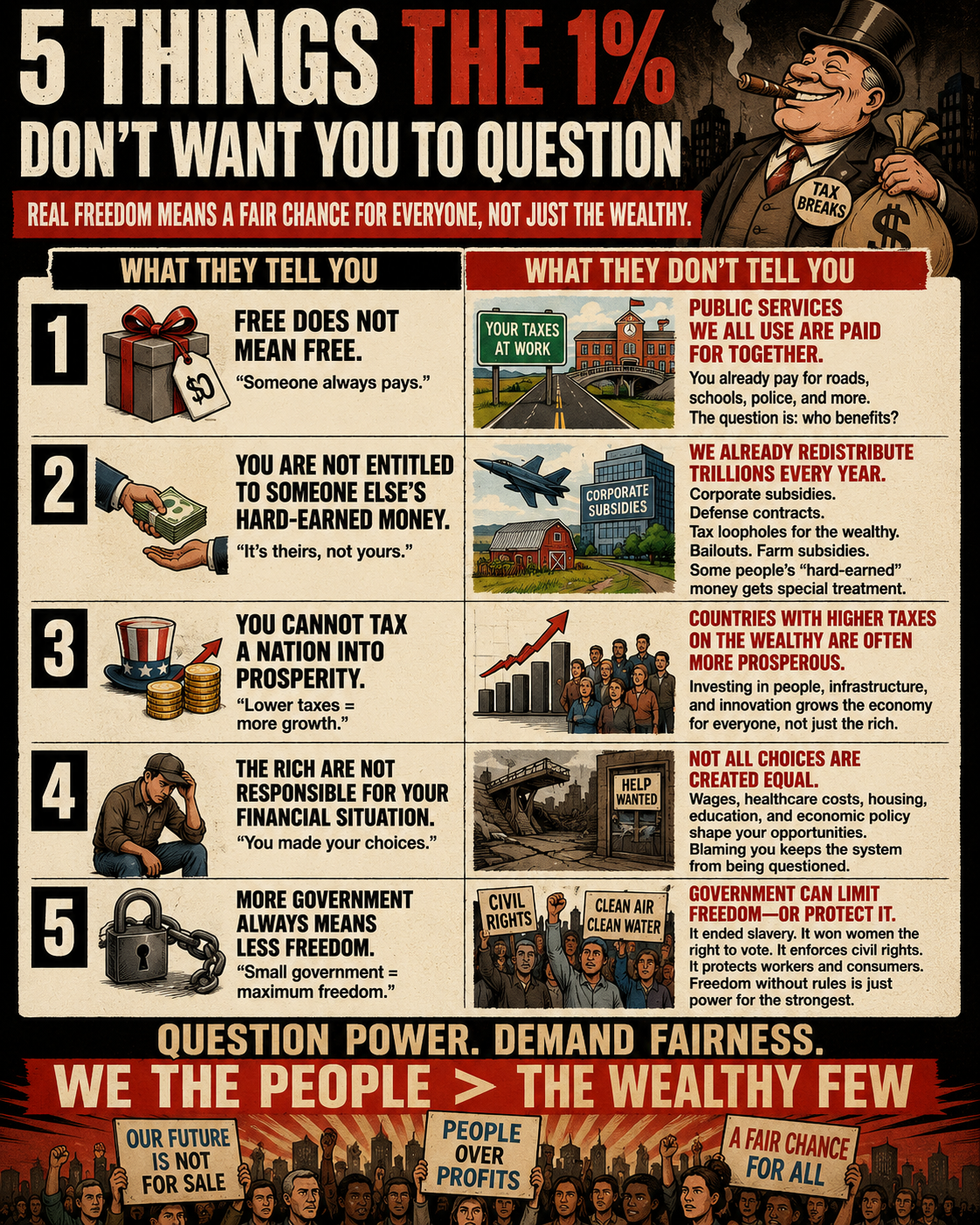
"Free does not mean free." "You are not entitled to someone else's money." These are the talking points. Here's what they never mention: we already redistribute trillions every year — to corporations, defense contractors, and the wealthy. The question is never whether redistribution happens. The question is always which direction it flows.
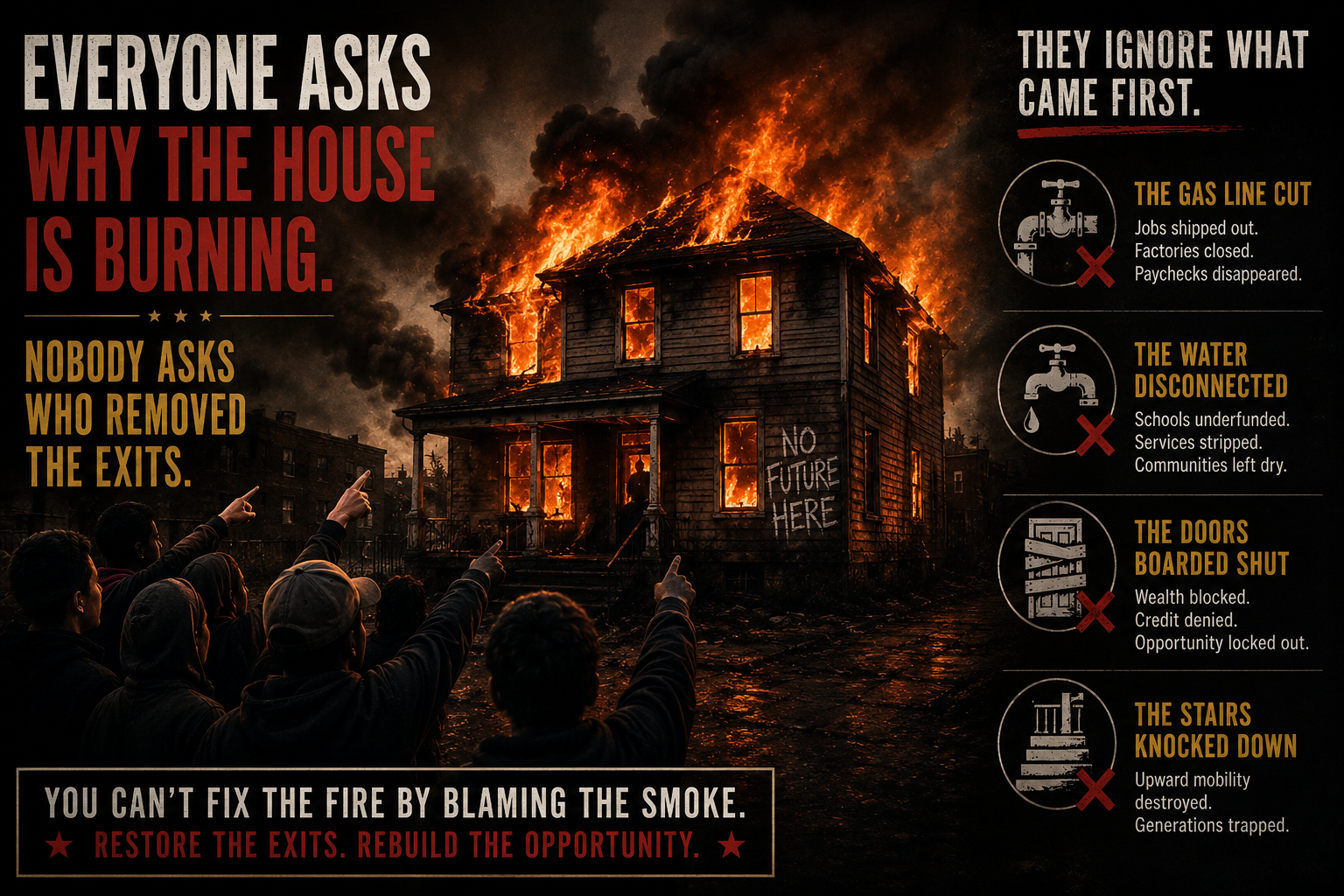
Nobody Asks Who Removed the Exits
Jobs shipped out. Schools underfunded. Wealth blocked. Upward mobility destroyed. Everyone points at the fire. Nobody asks who cut the gas line, disconnected the water, boarded the doors, and knocked down the stairs — or documents exactly when, and by whose vote.
// Why Facts Don't Change Minds
The Most Astonishing Thing a Psychiatrist Ever Observed
A British psychiatrist was once asked: of everything you have studied about human nature,
what surprised you most? His answer came almost immediately.
"The inability of people to change their minds despite overwhelming evidence to the contrary."
Not war. Not genocide. Not greed. The most astonishing observation from a lifetime studying behavior
was this: when facts collide with identity, people do not update. They double down.
This is not a character flaw. It is a documented cognitive mechanism — identity-protective cognition —
studied extensively by Yale Law School's Cultural Cognition Project. When information threatens
how someone sees themselves or their group, the brain processes it as a threat rather than data.
The more intelligent the person, the better they become at rationalizing the rejection.
This is why the quiz at the top of this page can show you a Supreme Court case citation and a National Archives
document and you might still feel the need to explain why it doesn't count.
That feeling is not logic. It is loyalty. And someone is profiting from that loyalty every single day.
// Signs You Are Protecting Identity, Not Seeking Truth
→You evaluate the source of a claim before you evaluate the claim itself — and the source's party affiliation determines whether you accept it.
→You can name every scandal attributed to the opposing party but struggle to name a single verified failure of your own.
→When presented with a primary source that contradicts your position, your first move is to question the source rather than engage with the document.
→You have never read a book by someone you politically disagree with — not to refute it, but to understand it.
→You feel that the other side's voters are the problem — and have never seriously asked who is funding the media telling you that.
You are not the problem. You were handed a broken information environment by people who profit from your confusion.
Recognizing the mechanism is the first step out of it.
Read the full investigation at Crisis of Truth →
// The Reading List
Read Before You Speak
How Many Have You Read?
Every book on this list was written by a Pulitzer Prize winner, a Harvard scholar,
an investigative journalist, a decorated military general, or a world-renowned economist.
Every single one has been read cover to cover — and these are just a fraction of the full list.
These are not opinion books. They are sourced to court records, federal documents,
named testimony, and peer-reviewed research. They are the books that explain,
in documented detail, how the rules of the game were written — and who wrote them.
Before you argue about which party is the problem, find out who funds both of them.